Buying guide · 11 min read
How much does rooftop solar cost in 2026? A 1–10 kW price guide after the PM Surya Ghar subsidy
What a home rooftop solar system really costs in India in 2026, size by size: the price before subsidy, the PM Surya Ghar subsidy, what you actually pay, the monthly saving and the payback, plus the line items that make two quotes differ.
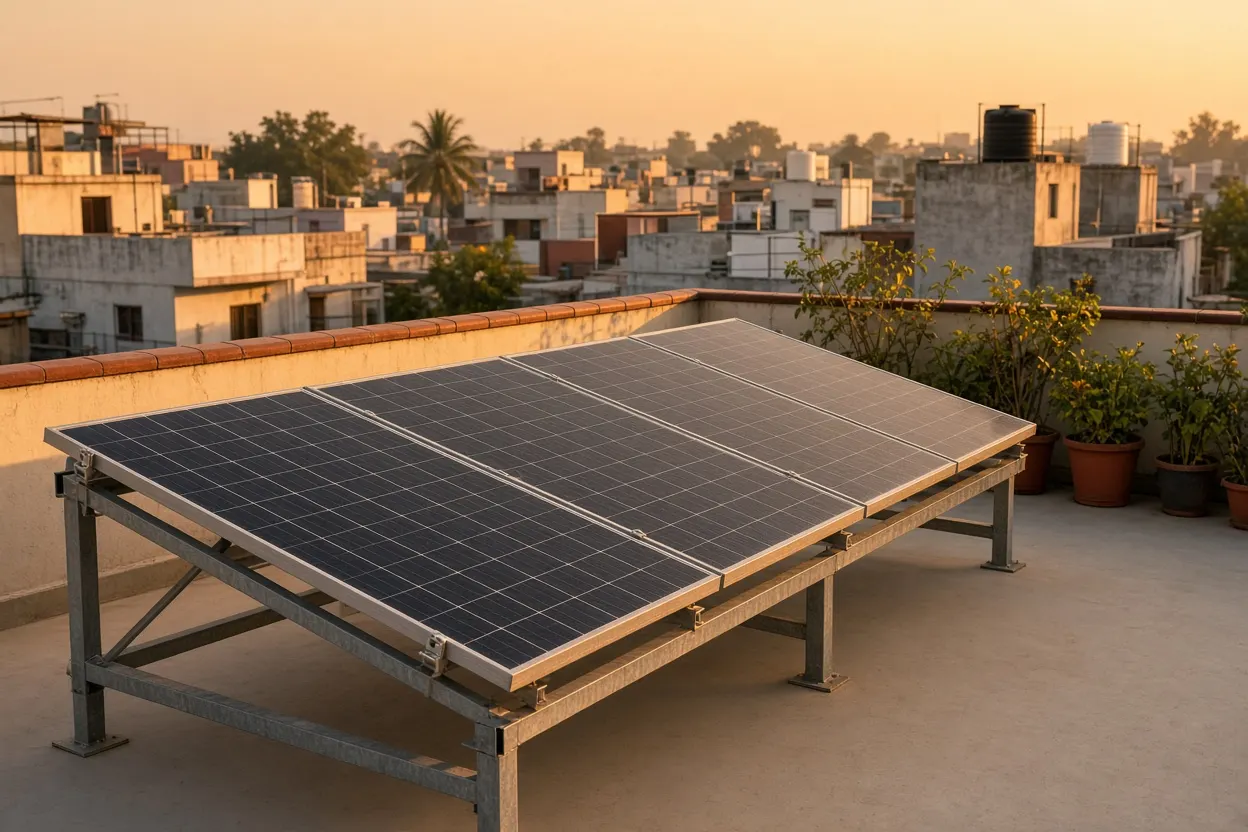
“How much will it cost?” is the first question almost every family asks us, and the hardest one to get a straight answer to. Installers quote a single number, every quote is different, and the subsidy makes the maths look confusing.
So here is the honest version: typical 2026 prices for a home on-grid system, size by size, what the subsidy really takes off, what you pay, and how quickly it comes back to you. Then we open up a quote line by line, so you can see where the money goes and why two quotes for “3 kW” can be ₹40,000 apart.
The short answer: price by system size
These are typical installed prices for a good-quality on-grid home system in 2026, using subsidy-eligible (DCR) panels, a reputable string inverter, a galvanised raised structure, and proper earthing and protection. Your quote will move within, and sometimes outside, these ranges depending on your roof and the brands you choose.
| System size | Suits a monthly bill of about | Price before subsidy | Central subsidy | What you pay |
|---|---|---|---|---|
| 1 kW | ₹800–1,000 | ₹55,000–70,000 | ₹30,000 | ₹25,000–40,000 |
| 2 kW | ₹1,600–2,000 | ₹1.1–1.4 lakh | ₹60,000 | ₹50,000–80,000 |
| 3 kW | ₹2,400–3,000 | ₹1.65–2.1 lakh | ₹78,000 | ₹0.87–1.32 lakh |
| 5 kW | ₹4,000–5,000 | ₹2.75–3.5 lakh | ₹78,000 | ₹1.97–2.72 lakh |
| 10 kW | ₹8,000–10,000 | ₹5.5–7 lakh | ₹78,000 | ₹4.72–6.22 lakh |
Two things stand out. First, the subsidy does the most work on small systems: it covers roughly half the cost of a 1–2 kW system but only about an eighth of a 10 kW one. Second, the price per kW falls a little as systems get bigger, because fixed costs like design, the inverter’s base cost, net-metering paperwork and the site visit are spread over more panels.
Size your system to your bill, not to the subsidy. The ₹78,000 cap is reached at 3 kW, but the right size is whatever your roof and your consumption justify.
How the PM Surya Ghar subsidy actually works
The central government’s subsidy (officially “central financial assistance”) for homes is:
- ₹30,000 per kW for the first 2 kW
- ₹18,000 for the third kW
- capped at ₹78,000 for any system of 3 kW or more
Housing societies and RWAs can claim ₹18,000 per kW for common-area systems (lifts, pumps, common lighting), up to 500 kW.
Three rules matter more than people expect:
- You pay the full price first. The subsidy is credited directly to your bank account after the system is installed, the net meter is fitted, the DISCOM inspects it and the commissioning report is uploaded. Plan your cash flow, or a loan, for the full amount.
- The vendor and the panels must be eligible. The installer must be registered for your DISCOM on the national portal, and the panels must be eligible domestically manufactured (DCR) modules. A cheaper quote with non-eligible panels can cost you the entire subsidy.
- Apply before you install. Registration and DISCOM feasibility approval come first. Systems installed before approval are a common reason applications get stuck.
Some states add their own top-up on the central amount. Check the current position for your state on the national portal or with your DISCOM before you count on it. In Jharkhand, that DISCOM is JBVNL.
What’s inside the price
A rooftop quote is really eight or nine things bundled together. Knowing them is how you compare quotes fairly.
- Solar panels (the biggest share). DCR panels cost more than non-DCR panels because the cells are made in India. Mono PERC is the common standard; TOPCon and bifacial panels produce a little more per panel and cost a little more.
- Inverter. For most homes, a single-phase or three-phase on-grid string inverter. Brand, warranty length and remote-monitoring support drive the price. A hybrid inverter with batteries costs much more; see our on-grid vs hybrid vs off-grid guide.
- Mounting structure. Hot-dip galvanised steel or aluminium. A raised structure you can walk under costs more than a low one, but keeps your terrace usable, is easier to clean and stays clear of monsoon water.
- Balance of system. DC and AC cables, connectors, the DC and AC distribution boxes (DCDB/ACDB) with surge protection, MCBs and isolators. This is where cheap quotes quietly save money.
- Earthing and lightning protection. Earth pits for the panels, inverter and AC side, plus a lightning arrester where needed. Invisible once installed, and essential for safety.
- Installation and commissioning. Labour, transport, and on-site testing.
- Net meter and DISCOM charges. The bidirectional meter and any application or testing fees. Ask whether these are included or billed to you separately.
- GST. GST on solar power systems was cut to 5% as part of the 2025 rate changes, which brought rooftop prices down. Make sure your quote shows GST clearly.
Why two “3 kW” quotes can be ₹40,000 apart
When families show us two quotes, the difference almost always comes from the same five places:
- DCR or non-DCR panels. Non-DCR panels make a quote look cheaper, but they make you ineligible for the subsidy. That one line can swing the real cost by more than the whole price difference.
- Panel wattage and count. “3 kW” could be six 545 W panels or seven 450 W panels. Check that the total really adds up to the capacity you’re paying for.
- Inverter brand and warranty. A 5-year and a 10-year warranty are not the same product, even at the same kW.
- Structure height and thickness. A low structure with thin, painted steel is cheaper today, and costs you later in rust, leaks and an unusable terrace.
- What’s quietly left out. Earthing, lightning arrester, net-meter charges, extra cable length to a distant meter, civil work on the roof. A low quote that excludes these isn’t low.
We see the same pattern on many roofs: the cheapest quote saves money in exactly the places you can’t inspect after handover. That’s why an itemised quote, with brands, models and quantities named, matters more than the total at the bottom.
Monthly savings and payback, worked out for Jharkhand
In Jharkhand, a well-placed, shade-free rooftop system generates roughly 3.9 units per kW per day averaged over the year: more in March–May, less during the monsoon. That’s about 117 units per kW per month.
The table below assumes your system offsets units you would otherwise buy at about ₹7.5 per unit, and that fixed and meter charges (roughly 15% of a typical bill) stay on your bill.
| System size | Units generated / month | Saving / month | Payback (mid-range price) |
|---|---|---|---|
| 1 kW | ~117 | ~₹750 | ~3.6 years |
| 2 kW | ~234 | ~₹1,490 | ~3.6 years |
| 3 kW | ~351 | ~₹2,240 | ~4.1 years |
| 5 kW | ~585 | ~₹3,730 | ~5.2 years |
| 10 kW | ~1,170 | ~₹7,460 | ~6.1 years |
Two honest caveats:
- Your tariff slab changes the answer. Smaller households often pay a lower per-unit rate in their first slab. If your effective rate is closer to ₹5 than ₹7.5, the savings above fall by about a third and payback stretches accordingly. That’s why we start every consultation with 12 months of your actual bills.
- Shade and orientation matter more than brand. A water tank’s shadow across one row of panels at 2 pm can cost more output than the difference between two panel brands. A proper site survey checks this before anyone quotes you.
After payback, the system keeps producing for the rest of its 25-year life, with panel output declining slowly (around 0.5% a year). Over that life, a 3 kW system in Jharkhand can save several lakh rupees at today’s tariffs, and more if tariffs rise.
Want this worked out for your own bill and roof? Use our solar calculator. It runs the same logic for your state and shows the subsidy, net cost and payback instantly.
The costs nobody puts on the first quote
Before you sign, ask the installer to confirm in writing whether each of these is included:
- Net meter supply, testing and DISCOM application fees
- Extra structure height, or a special structure for a tin-shed or sloped roof
- Cable runs longer than the standard allowance (for example, when the meter is far from the roof)
- Waterproofing at anchor points, or a non-penetrating ballasted structure
- Lightning arrester and the number of earth pits
- Annual maintenance (AMC) after the first year, and what it covers
- Who files the subsidy paperwork, and who follows up if it stalls
Paying for it: loans and EMIs
Because you pay the full price before the subsidy arrives, many families use a loan. Public-sector banks offer collateral-free loans for residential rooftop solar under PM Surya Ghar, with concessional rates for systems up to 3 kW and longer tenures than a typical personal loan. Margin money, rates and limits differ from bank to bank and change over time, so compare current terms from two or three lenders. Line up the loan paperwork alongside your subsidy application so installation isn’t held up waiting for funds.
A five-minute checklist for comparing quotes
- Are the panels DCR and subsidy-eligible? Brand, model and wattage named?
- Do panel count × wattage add up to the capacity quoted?
- Inverter brand, model and warranty named? Remote monitoring included?
- Structure material, galvanisation and height specified?
- Earthing, lightning arrester, DCDB/ACDB and cables itemised, not “as required”?
- Net meter and DISCOM charges included or excluded?
- GST shown separately?
- Who files the subsidy, and is the vendor registered for your DISCOM?
- Warranty and AMC terms in writing?
If a quote can’t answer these clearly, that tells you something too.
Where Baidyanath Solar fits in
We are solar consultants based in Deoghar. We read your bills, survey your roof, design a system sized to your real consumption, compare installer quotes line by line, file your PM Surya Ghar application and check the installation against the design. If solar doesn’t make sense for your home yet, we’ll tell you that too.
Book a free consultation and send us your last electricity bill. We’ll tell you what size fits and what it should cost.
Frequently asked questions
What is the price of a 3 kW solar system with subsidy in 2026?
A good-quality 3 kW on-grid home system typically costs about ₹1.65–2.1 lakh before subsidy. The PM Surya Ghar central subsidy for 3 kW is ₹78,000, so your net cost is roughly ₹0.87–1.32 lakh. You pay the full amount first; the subsidy is credited to your bank account after the system is commissioned.
Is the subsidy more if I install 5 kW or 10 kW?
No. The central subsidy for homes is capped at ₹78,000, which you reach at 3 kW. A bigger system can still make sense if your bill is high, but the extra kilowatts are paid for entirely by you.
Why are DCR panels more expensive, and do I need them?
DCR (domestic content requirement) panels use Indian-made solar cells, which cost more than imported cells. To claim the PM Surya Ghar subsidy, your system must use eligible domestically manufactured panels, so for a subsidised home system, yes, you need them.
How long does a rooftop solar system last?
Good panels carry a 25-year performance warranty and usually keep producing beyond that, with output falling slowly (around 0.5% a year). Inverters typically last 8–12 years and are the one major part you should budget to replace once.
Can I get a loan for rooftop solar?
Yes. Public-sector banks offer collateral-free loans for residential rooftop solar under PM Surya Ghar, with concessional rates for systems up to 3 kW. Rates and margin requirements change, so compare the current terms from two or three banks before you apply.
Sources & further reading
- PM Surya Ghar: Muft Bijli Yojana, national portal (subsidy, vendors, loans)
- Ministry of New and Renewable Energy (MNRE)
- JBVNL: CFA structure for PM Surya Ghar (PDF)
- The Tribune: GST on renewable energy devices rationalised to 5%
- pv magazine India: bank financing for PM Surya Ghar rooftop customers (example terms)
Scheme rules, tariffs and prices change. We re-check this guide regularly; the date at the top shows the last update.
Talk it through with a consultant
Straight answers on WhatsApp, or a free call at a time that suits you.