Farms & solar pumps
Solar pumps & farm solar in Deoghar
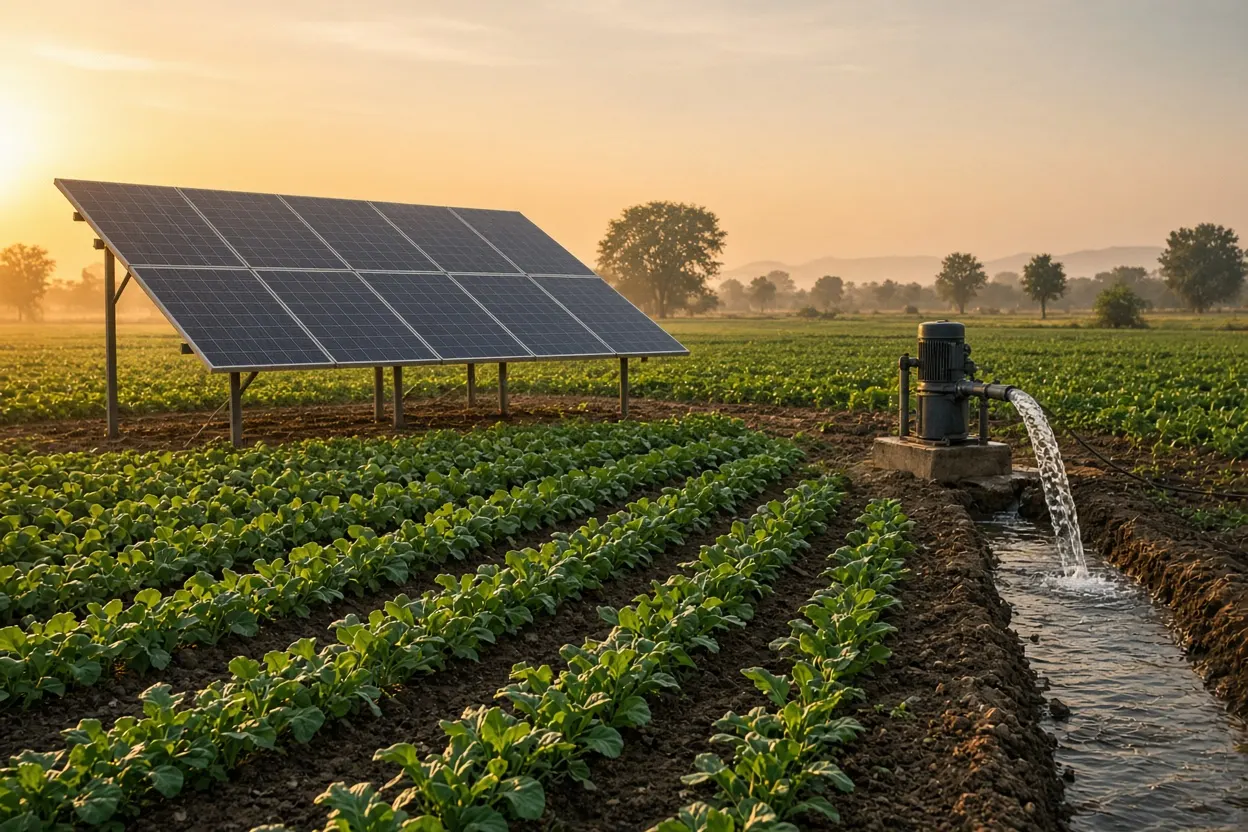
Daytime irrigation without diesel. We size the pump to your well and crop, guide you through PM-KUSUM and your state’s share, and make sure the installation is built to last in the field.
Quick check
Is a solar pump right for your farm?
You irrigate in daylight
Solar pumps run while the sun shines. Most crops and drip systems fit a daytime watering pattern well.
You spend on diesel or have poor grid
If your pump runs on diesel, or farm feeders give power at odd hours, the savings and convenience are large.
Shade-free land near the source
The panel array sits close to the borewell or canal, on land that stays clear of trees and crops through the year.
Not sure? Send us your bill and we’ll tell you honestly, for free.
PM-KUSUM explained
Three ways the scheme supports farmers.
The central government funds part of the cost and states add their own share. Shares, the farmer’s contribution and application windows differ by state, so we check your state’s current terms before you apply.
Solar plants on farmland
Small, decentralised grid-connected plants on barren or fallow land. The farmer or a developer sells the power to the DISCOM.
Standalone solar pumps
Off-grid solar pumps that replace diesel pumps where there is no grid connection. The most common route for individual farmers.
Solarising grid-connected pumps
Adds solar to existing grid-connected pumps, individually or at feeder level, so surplus power can be sold to the DISCOM.
Pump sizing
Pump HP to panel kW.
A common rule of thumb is roughly 1 kWp of panels per HP of pump. The right size depends on water depth, the flow your crop needs and how you irrigate, which is why we measure the source first.
Size my pump| Pump size | Panel array (approx.) | Shade-free land (approx.) |
|---|---|---|
| 1 HP | ≈ 1 kWp | ≈ 100 sq ft |
| 2 HP | ≈ 2 kWp | ≈ 200 sq ft |
| 3 HP | ≈ 3 kWp | ≈ 300 sq ft |
| 5 HP | ≈ 5 kWp | ≈ 500 sq ft |
| 7.5 HP | ≈ 7.5 kWp | ≈ 750 sq ft |
| 10 HP | ≈ 10 kWp | ≈ 1,000 sq ft |
Indicative only. Final sizing follows a site and water-source survey.

What’s included
Our consultancy, start to finish.
- Water source study: depth, yield and head
- Pump type and HP sizing for your crop pattern
- Panel array, structure and controller specification
- PM-KUSUM eligibility check and application guidance
- Vendor comparison among empanelled suppliers
- Installation supervision, earthing and theft-proofing
- Farmer training on operation and cleaning
- Yearly field check
Quick estimate
What would solar save you?
Move the slider to your monthly bill. For a full breakdown with costs, 25-year savings and CO₂, use the full calculator.
Related projects
Projects like yours.
Every case study shows the bill before and after, because that’s the number that matters.
View all projects
What is PM-KUSUM?
PM-KUSUM is the central scheme for solar in agriculture. It supports standalone solar pumps, solarisation of existing grid-connected pumps, and small solar plants on farmland. The central and state shares, and the farmer’s contribution, vary by state and component, so we check your state’s current terms before you apply.
Can a solar pump run at night?
A standard solar pump runs only in daylight. If you need water at night, the usual approach is to pump into a storage tank or farm pond during the day. Batteries for pumps are rarely economical.
How many HP do I need?
It depends on water depth, the flow you need and the irrigation method. Over-sizing wastes money and under-sizing starves the crop, which is why we measure the source before recommending a pump.
What about theft and damage?
We specify anti-theft fasteners, sturdy structure and proper earthing, and recommend insurance. Panels sit high enough to clear grazing animals and flood water.
Not sure where to start? Start with your bill.
Send us your last electricity bill. A consultant will tell you, for free, what size system fits and what you could save.