Buying guide · 7 min read
On-grid, hybrid or off-grid: which solar system is right for your home?
The three kinds of rooftop solar system explained in plain English: how each one works, what it costs relative to the others, and the questions that decide which one fits your home.
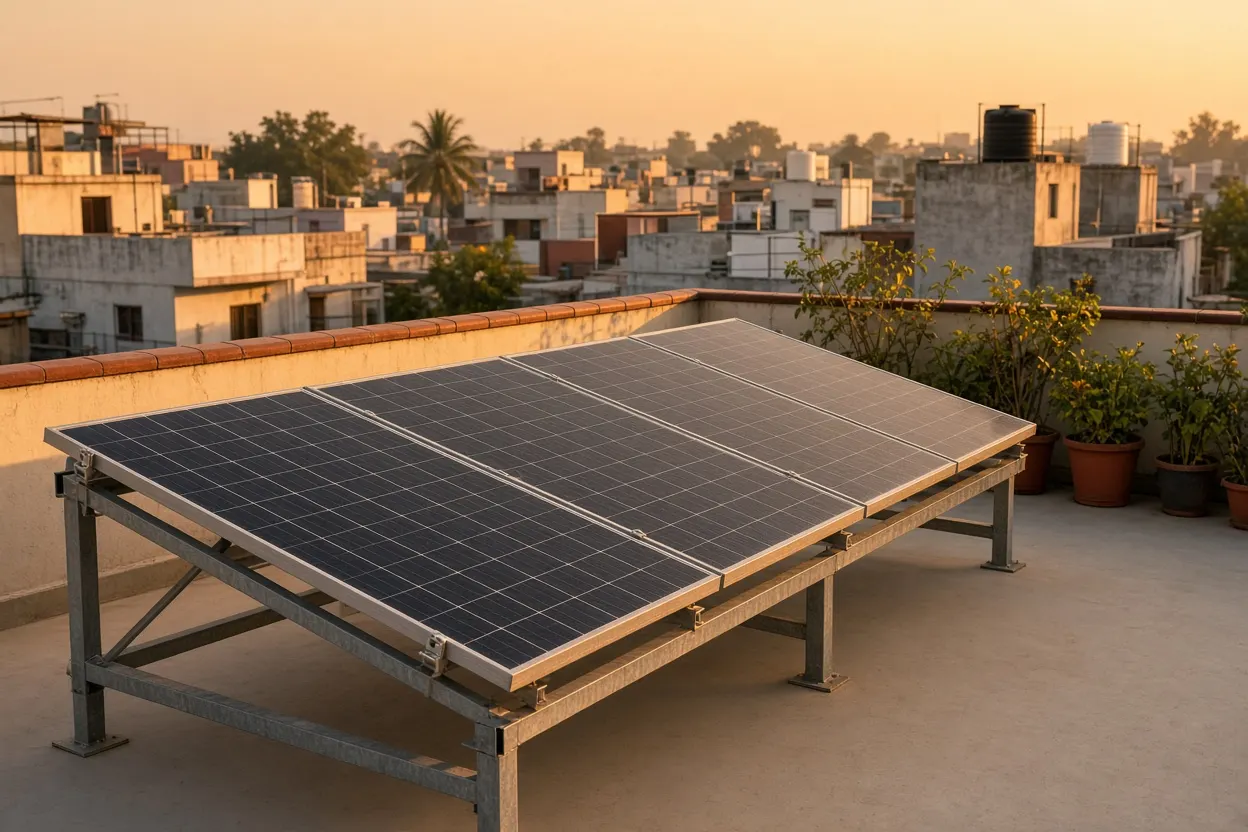
The first decision in any rooftop solar project isn’t the panel brand or the installer. It’s the type of system. Get this wrong and you either pay for batteries you don’t need, or you end up sitting in the dark during a power cut, wondering why your new solar panels aren’t working.
There are three types: on-grid, hybrid and off-grid. Here is how each one works, who it suits, and the questions we ask every client before recommending one.
On-grid (grid-tied) systems
An on-grid system connects your panels to the electricity grid through an inverter and a bidirectional (net) meter. There is no battery.
During the day your home uses solar power first. If the panels produce more than you are using, the surplus is exported to the grid and recorded by the net meter. At night, or on a cloudy afternoon, you draw power from the grid as usual. Your bill is calculated on the difference between what you imported and what you exported, according to your DISCOM’s net-metering rules.
What it’s good at
- Lowest cost per kW, because there are no batteries to buy or replace.
- Highest efficiency: almost every unit the panels generate is either used or credited.
- Eligible for the PM Surya Ghar central subsidy for residential systems.
- Very little maintenance beyond cleaning and a yearly health check.
The catch
An on-grid inverter shuts down when the grid fails. This is a safety requirement called anti-islanding: it stops your system from pushing power into lines that line workers may be repairing. So during a power cut, an on-grid system gives you no backup, even at noon in full sun.
If your area rarely has long power cuts, on-grid is almost always the best-value choice.
Best for: homes in areas with reliable grid supply, families whose main goal is a lower bill, and anyone who wants the fastest payback.
Hybrid systems
A hybrid system is an on-grid system with a battery added, managed by a hybrid inverter. It still connects to the grid and can still use net-metering, but it can also store energy and keep chosen circuits running when the grid fails.
In normal operation, solar power runs your home, then charges the battery, then exports any surplus. During a power cut, the inverter isolates your home from the grid and runs your backup loads from the battery and panels.
What it’s good at
- Backup during power cuts, without a separate inverter-and-battery setup.
- Lower bills from net-metering, as with an on-grid system.
- Flexibility: you choose which circuits are backed up (lights, fans, fridge, Wi-Fi, a pump).
The catch
- Higher upfront cost. Batteries are the most expensive component per unit of energy, and they need replacing during the 25-year life of the panels. Lithium batteries last longer than lead-acid, but cost more upfront.
- Some energy is lost every time a battery charges and discharges.
- Sizing matters more. An undersized battery disappoints; an oversized one wastes money.
Best for: homes that face frequent or long power cuts, people working from home who cannot afford downtime, and families who want backup for essentials as well as a lower bill.
Off-grid systems
An off-grid system has no connection to the electricity grid. Panels charge a battery bank, and the home runs entirely on that stored and generated power.
What it’s good at
- Works where there is no grid connection, or where connecting would be very expensive.
- Complete independence from DISCOM supply and tariffs.
The catch
- The battery bank has to cover every night and every cloudy spell, so it is large and expensive.
- In the monsoon or in winter, generation can fall short, and you need either a much bigger system or a backup generator.
- No net-metering, so surplus power on sunny days is wasted once the battery is full.
- Residential grid-connected subsidies don’t apply in the same way.
Best for: remote farmhouses, homestays and sites where grid power is unavailable or extremely unreliable. For most city and town homes with a grid connection, off-grid is the wrong choice.
A quick comparison
| On-grid | Hybrid | Off-grid | |
|---|---|---|---|
| Grid connection | Yes | Yes | No |
| Battery | No | Yes | Yes (large) |
| Backup in a power cut | No | Yes, for chosen loads | Yes, whole home |
| Net-metering | Yes | Yes | No |
| Relative upfront cost | Lowest | Medium to high | Highest |
| Battery replacement | Not needed | Needed over system life | Needed over system life |
| Typical payback | Fastest | Slower | Slowest |
Five questions that decide it
When we design a system, these are the questions that settle the choice.
1. How often does your power go out, and for how long?
Check your last few months honestly. A few short cuts a month is a very different situation from daily multi-hour outages. If you already own an inverter and battery that cover your short cuts, an on-grid system alongside it can be the cheapest combination.
2. What do you actually need during a cut?
Backing up lights, fans, Wi-Fi and a fridge needs a far smaller battery than backing up air conditioners or a water heater. We list your essential loads and size the battery for those, not for the whole house.
3. How much is your monthly bill, and what drives it?
Solar saves the most where daytime consumption is high and the tariff slab is steep. Your bill history tells us how big the system should be, and whether a battery would ever pay for itself on savings alone (usually it doesn’t; it pays for itself in comfort).
4. Does your DISCOM offer net-metering for your connection?
Most residential connections in India are eligible, but rules on system size, sanctioned load and export credit differ by state. We check the current regulations for your DISCOM before you commit.
5. What is your budget, and how long do you plan to stay?
If you expect to move in a few years, the fastest payback (on-grid) usually wins. If you are building your forever home, a hybrid system or a battery-ready inverter you can expand later may make more sense.
Our usual recommendation
For most homes with a reasonably stable grid supply, an on-grid system sized to your bill gives the best return, and it qualifies for the residential subsidy. Where power cuts are a genuine problem, a hybrid system with a battery sized only for essential loads gives you backup without paying for capacity you won’t use. Off-grid is the right answer only where there is no practical grid connection.
The right answer depends on your roof, your bill and your outages, which is why we start every project with a bill review and a site survey, not a brochure.
Talk it through with a consultant
Straight answers on WhatsApp, or a free call at a time that suits you.